


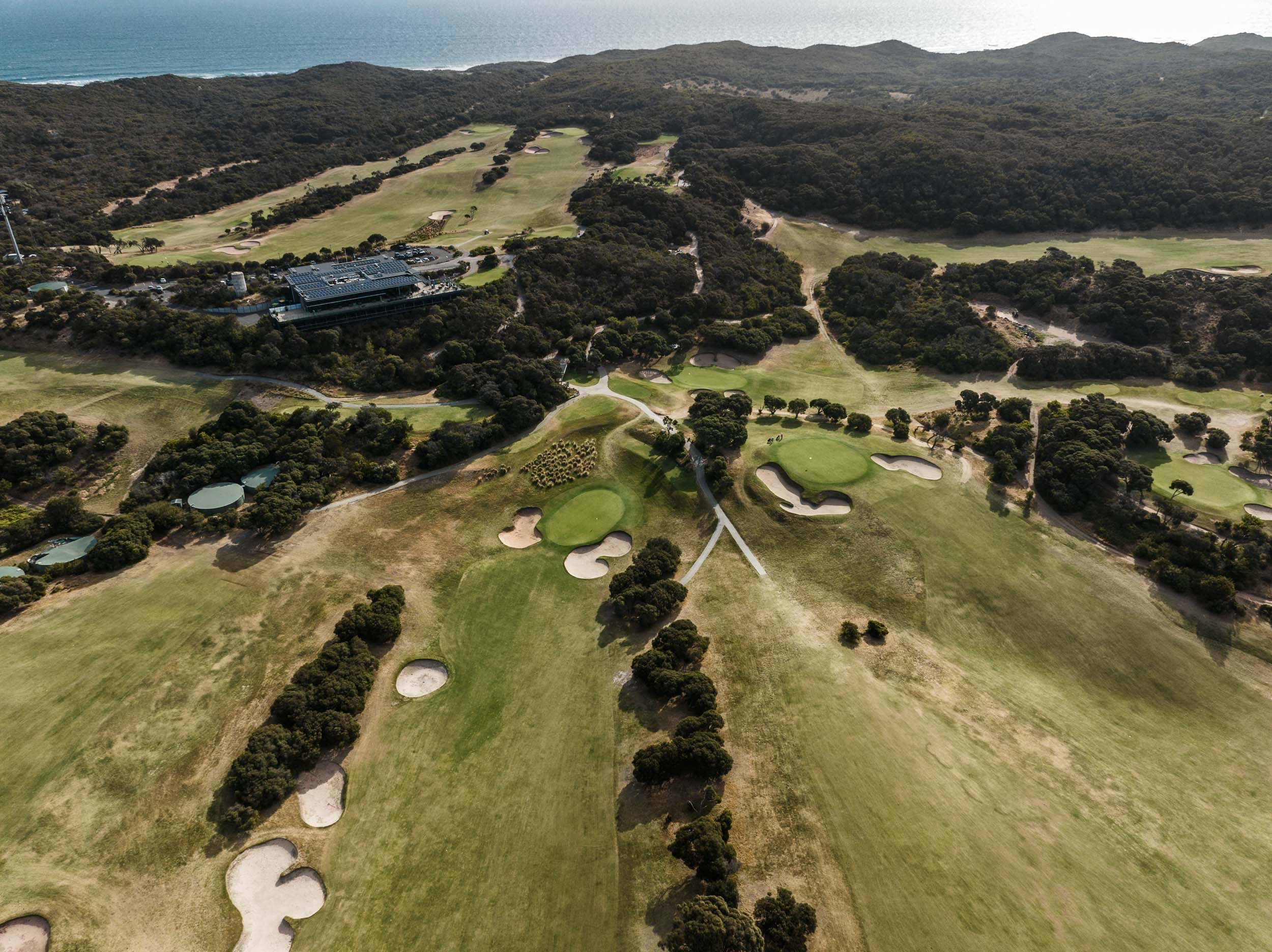
Because so many of Australia’s finest courses are played over relatively flat pieces of ground, there’s an assumption that hilly golf isn’t very good golf. It’s a view exacerbated by just how few good hilly courses we have. The irony is if you gave Australian golfers a choice of playing one course in the world, most would pick Augusta National, which might be the hilliest of the best 500 courses in the world.
Victoria’s finest golf is played over perfectly undulating ground, with Royal Melbourne being the best and oldest example. The back nine holes at Victoria, much of Peninsula Kingswood and most of the post mid-80s Mornington Peninsula golf is laid out over brilliant property, but long-ago Portsea’s founders identified, either by accident or design, one of the most dramatic sites for golf in the country. The point-missers complain about the hills and, at the same time, completely miss the very thing that makes the golf at Portsea both exhilarating and enduringly interesting.
It’s always fascinating to study how an architect uses the land. Relatively flat sites, including Commonwealth, Huntingdale, Metropolitan, Woodlands and Yarra Yarra, make the task somewhat easier.
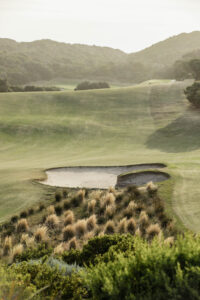
View back up 18 fairway
You could, for example, tee off the 18th green at Metropolitan and play the entire routing in reverse and it’d still be an excellent course.
Can you imagine playing Portsea’s 18th in reverse? Or the 14th?
The brilliance of Portsea is how those who formed and evolved the course into a full 18 holes found the obvious holes – the 2nd, 3rd,4th,8th,11th, 16th and 17th – and still made the much more difficult land work so well. It’s not easy to make good golf on the land the 5th, 6th, 9th, 10th and 12th holes play over, but it makes for unusual, unconventional and successful golf.
“Australians know how to take care of their courses, staying on the lean side, conserving water, and taking care of their native grasses.”
– Ben Crenshaw.
Most golfers judge the condition of a golf course by the state of the playing surfaces – the fairways, greens, tees and the bunkers. Bunkers are the easiest targets for complaining members because the shot from sand is the only one you can never play properly with a poor technique. It’s also the one surface easy to find fault with – “too hard”, “too soft”, “too dry”, “too wet”, “downhill lie”, “uphill lie”, “plugged ball”. It’s an almost inexhaustible list of excuses.
The real measure of the condition of a golf course is not simply the playing surfaces, but rather everything inside the boundary fences. If we use it as the measure, Portsea is one of the best-conditioned courses in the state. The vegetation is almost entirely indigenous, there are almost no trees interfering with the play. And if you asked every member if the golf course should “feel natural”, you’d find universal agreement.
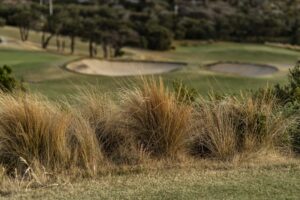
Course Vegetation
The surest way to make a golf course feel unnatural is to plant it with trees that have no relationship or relevance to the site. Bruce Grant’s diligence in promoting the ideal – and removing the “exotics” – is one of the major reasons for the improvement in the course over the last 35 years.
Grant lived by an adage he likely learned from his mentor, Claude Crockforn, the long-time Royal Melbourne superintendent: “Every superintendent is judged by his greens.” No-one managed Portsea’s greens better than Bruce.I remember hitting a wedge into the 15th green in the late 1980s and the ball pitched in to the soft green and never came out of its pitch mark. Mushy golf by the sea is an inexcusable crime, and once Bruce took over the maintenance of the greens in the early 1990s, they were the closest surfaces in the country to Royal Melbourne. Crockford had never seen a green too hard or too fast, and it was a principal Bruce took to heart and, at times, to extremes.
“Fairways can be too good. It does not make for good golf for the turf to ‘support’ the ball.”
– Tom Simpson
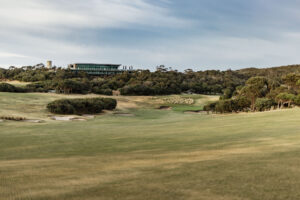
The variation of colour in the fairways
There is also a subtle but important distinction between perfect fairways and fairways that are perfect for golf. The former offer consistency of colour and the near-certainty of a “perfect lie”. The lies almost never vary on a “perfect fairway”. But the original seaside game was played on fairways that changed colour depending on the weather, and the lies varied enough for players to have to at least consider how the ball might react.
Portsea’s fairways have always been perfect for golf, while at the same time changing colour with the seasons, often with individual fairways being a wild mix of green and brown and every shade in between.
Just as fairways on seaside courses should be.