
Wild, Crazy Land
As the garden Arthur Relph planted turns 100, it’s timely to revisit the words of Portsea’s founding father about a stretch of land he saw as “a means of bringing health and pleasure to very many people”.
“Perhaps, there is nothing in the world that gives more joy than the creation of something beautiful, especially to its creator,” Relph wrote. “A man lays out a garden, prepares the soil, arranges the beds, plants the seeds and shrubs, watches the flowers come to life and grow to maturity, and his sense of complete pleasure and happiness is worth all the labour that has been involved.
“How much more joy must there be in the creation of a golf links which will go down to the generations to come. The project is bold owing to its immensity. The work is difficult. It is a work not of days but of years – but as the years go by the work becomes more and more beautiful and complete.”
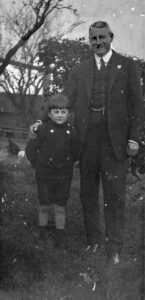
Arthur Relph standing next to son
Pat Long, granddaughter of Arthur Relph and daughter of Life Member Jack, has many letters written by father to son. They invariably train a critical eye on the golf course, bemoaning grass that was growing faster than it could be cut, greens that needed top-dressing or rough that reached up to the knees. Pat reports that, although a member of Riversdale and later Metropolitan, Arthur loved Portsea “and in a way lived for it”. To accompany him on a round during beachside school holidays was to hear his vision first-hand.
“As he played he would talk to us about things he noticed that needed to be done to the course – I was the caddy and my brothers played with him, while our dog hunted rabbits,” Pat recalls. “My youngest brother remembers having to help plant fairways with grass seed. I remember a lot of discussion about planting kikuyu grass and various trees. Many meetings with Jack Howard took place. I think my father inherited his father’s passion for the Club and no doubt learned much from him.”
Not all that Arthur introduced at Portsea was met with universal approval (more on his penchant for Cypress trees later). But after commissioning Jock Young to design the original 9-hole layout in 1924, it soon became apparent the best result would come from utilising the natural terrain wherever possible – if only to ease the immense workload of clearing the dense Ti-tree that dominated the site. Ever since, giving the natural assets room to breathe and thrive has been Portsea’s secret sauce.
“It’s great land – wild, crazy land,” says Mike Clayton, who first played the course as an early teenager around 1970 and has had input in many course tweaks since. As a golf architect, he knows the prized pedigree Portsea boasts in this hallowed space, not least through an association with the first Australian-born “rock star” of course design, Alex Russell, that began in 1929.
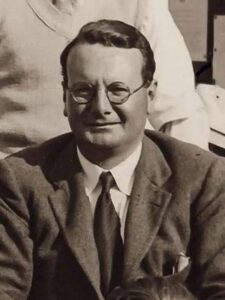
Alex Russell
Small degrees of separation connect Portsea to the cream of golf architecture royalty. Geelong-born Russell had attended Cambridge with Dr Alister MacKenzie, the Yorkshire surgeon whose career change was such a roaring success that his courses – from Royal Melbourne to Augusta – are lauded around the world. When MacKenzie ventured ‘Down Under’ in 1926, the pair reconnected and Russell became his Australian business partner. He favoured a simple approach to Portsea’s greens: slopes were to be gentle; no straight embankments or straight lines of any sort around greens; greens to be flat and level within five yards of the pin.
MacKenzie’s design of another hallowed American course, Crystal Downs in Michigan, gives Portsea some global context. A decade or so ago, Clayton stood on the 10th tee at Portsea with another revered golf course designer, Tom Doak, who with Clayton is responsible for Barnbougle. Doak’s primary-school-aged son Michael was with them.
“Tom asked him, ‘What’s this course remind you of Michael?’” Clayton recalls.
“And this 10-year-old kid said, ‘It’s just like Crystal Downs, Dad.’
“And Doak said, ‘That’s what I thought.’”
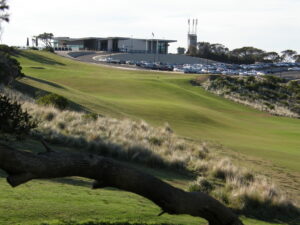
New clubhouse & new routing
Clayton notes that MacKenzie believed a well-designed golf course should not be overly tampered with. “He was massive on finality – build it properly and don’t change it.” Of course, change was necessary at Portsea to grow the course from the initial nine holes to 12 (in 1932), up to 14 (in 1957) and finally to 18 in 1965. Situating the clubhouse and hotel close to the middle of the layout demanded another re-routing, landing the course where it is today.
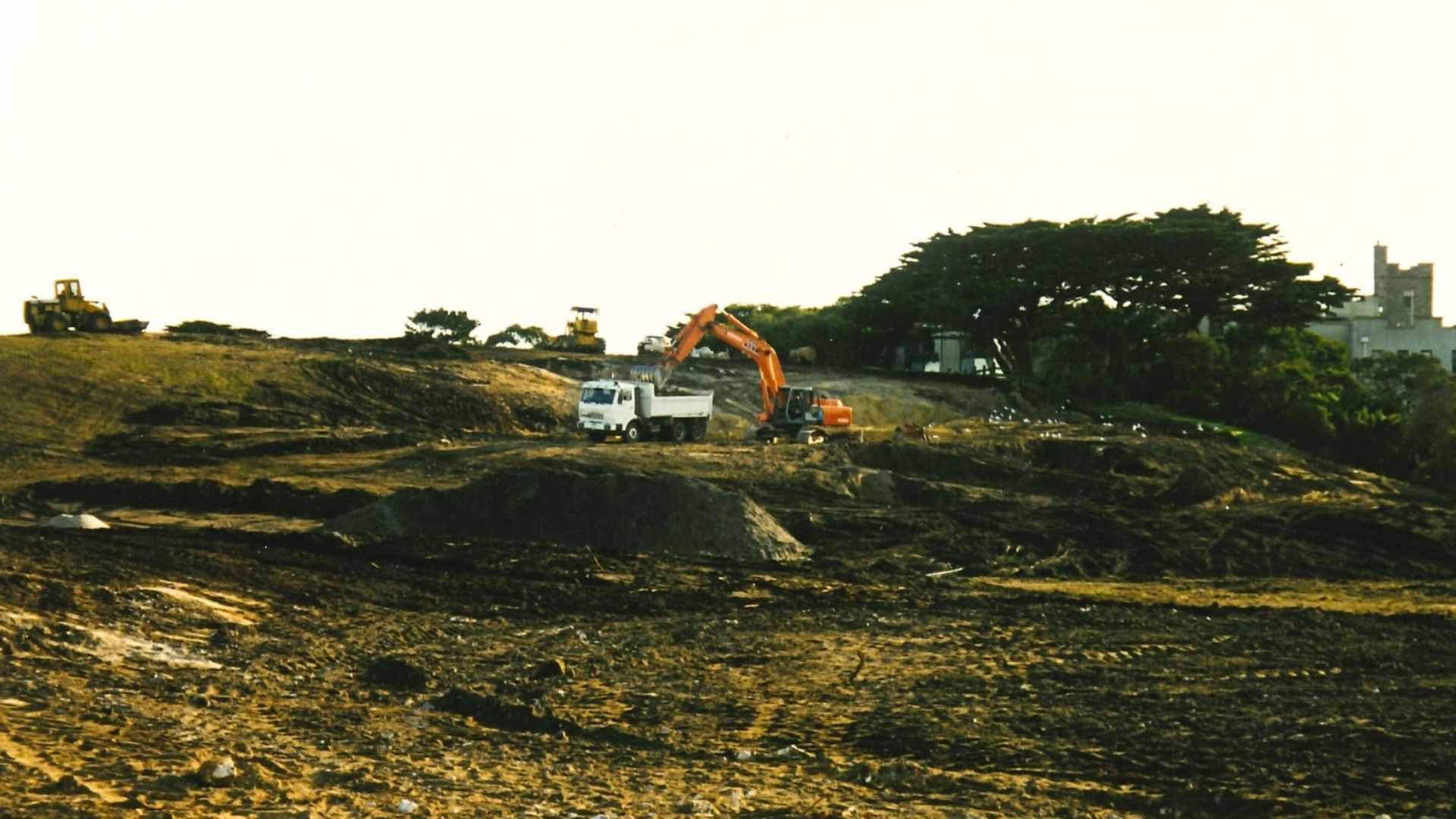
It’s been some journey. The 1st and 10th tees and 9th green all went in the land sale that funded the big move and the necessary changes to the course were undertaken by Tony Cashmore’s design team. If re-routing has at times confused members, spare a thought for those tending the course.
Brad Harris first experienced Portsea as a 12-year-old in Gordon Beany and Syd Thomson’s Saturday morning junior program. By age 26 he was captain of hat-trick-winning Portsea’s Division One pennant team, locking horns with Wilson who spearheaded Rosebud. He was a member for 41 years and had two stints working on the course, initially for a dozen years until the late 1990s and then as superintendent from 2010-14.
Harris laughs to recall asking Bernie Lynch (Harris was Bernie’s apprentice when his greens-keeping career began in 1986) to go and cut the rough on the 7th. “And Bernie said, ‘You mean the 12th?’ Another time he asked someone to spray the par 5 3rd and they went out and tackled the par 3 16th instead. “I walked into the shed one day, slammed my book down and said, ‘Right! We’re talking in the new from now on – there’s no more old!’”
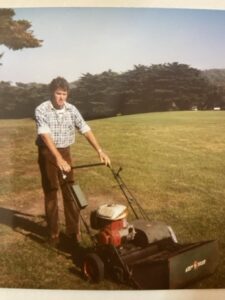
Bernie Lynch
The club marks its centenary with Clayton DeVries and Pont (CDP Golf) overseeing the course’s stroll towards 200. Portsea is especially fortunate to have Mike DeVries involved in consulting, in Clayton’s view “one of the great architects in the world”. Whether on a whim or through necessity, the course has changed – dramatically at times, subtly at others – far more than Dr MacKenzie might have liked. Yet nothing has diminished what another influential Portsea hand, the late Bruce Grant, hailed as “such a brilliant piece of golf country”.
Golf course appreciation can be akin to art – we see things through our own lens. It was here that Arthur Relph and another Portsea pioneer, AO Barrett, clashed regularly in the club’s early years – particularly around the excitable Barrett’s penchant for making changes to the course with the breeziness of rearranging furniture. Indeed, Jack Relph joked that every time his father arrived at the course Barrett had changed more holes.
Others were influential in those formative years, including the champion New Zealand golfer Sloan Morpeth. He moved to Melbourne in 1930 and had a hand in laying out some early holes. In 1934 Morpeth married Susie Tolhurst, who would twice win the Australian amateur championship. She also inspired a move that would make Portsea a trailblazer.
The Bull’s Roar records Tolhurst reprimanding AO Barrett: “Courses are built for men, they are not suitable for women … half the people on this earth are women.” In a flash Barrett saw a more equitable way.
“Build one for both men and women and you please all holiday golfers.” Henceforth, Portsea provided ladies tees.
Whether referred to as greens-keeper or superintendent, Portsea has been blessed by a host of committed and talented people who have cared for the golf course. That they connect its earliest incarnations with today’s layout via just a few degrees of separation heightens the sense of history.
After Jock Young designed the first nine holes, Sandy Cunningham became the club’s first greens-keeper. By the late 1920s Jack ‘The Boy’ Howard was assisting. With Portsea turning 100, Kyle Wilson is superintendent and Bernie Lynch is winding down after half a century spent getting to know every inch of land and the location of pretty much every pipe. When Lynch was first employed by another long-timer, Jim Suttie, Howard was still around – no longer a boy, rather an old man who would drop into the machinery shed and tell stories connecting Portsea past and present.
Of course, there are more ground staff today (seven, including four qualified greens-keepers and two apprentices), and the machinery they employ doesn’t have four legs and a liking for carrots. Early maintenance featured greens being cut by hand mower on Tuesdays and Fridays; until 1935 fairways were cut using a horse-drawn gang mower roughly a metre wide. Jack Howard remembered taking a day to mow a single fairway. A Berrigan fairway mower was the first upgrade, replaced by a reconditioned gang mower in 1946. The club then had to wait until petrol rationing was lifted in 1948 to buy a tractor to pull it.
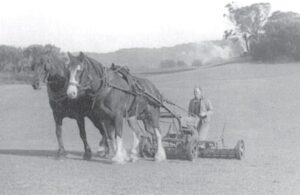
Jack Howard operating horse drawn mower
Bill McGrath became curator in 1949, with the Peninsula Post reporting after the Open tournament that year that Portsea “under the care of W.McGrath is now one of the best outside the metropolitan area”. Morpeth was again influential in the expansion to 18 holes, which became possible after a further 32 acres were leased from the Department of Interior and Department of Army in 1962 (taking Portsea’s footprint beyond 100 acres).
By this time Sandy Cunningham had retired after more than three decades dedicated to turning a wilderness into a golf course. Morpeth submitted two plans for the 18-hole course and Jack Howard contributed a third, with the final layout incorporating many of Howard’s suggestions that had initially been overruled. He deserves great credit for the course today, having undertaken an immense workload over many years with only three permanent ground staff and occasional casual help.
The 4th hole is called Jack Howard. Clayton recalls working on the hole and someone saying the new tee position was where Howard believed it should be, before Sloan Morpeth won out and placed the tee higher and further to the right. “Jack was right,” Clayton says. “It’s much better lower down.”
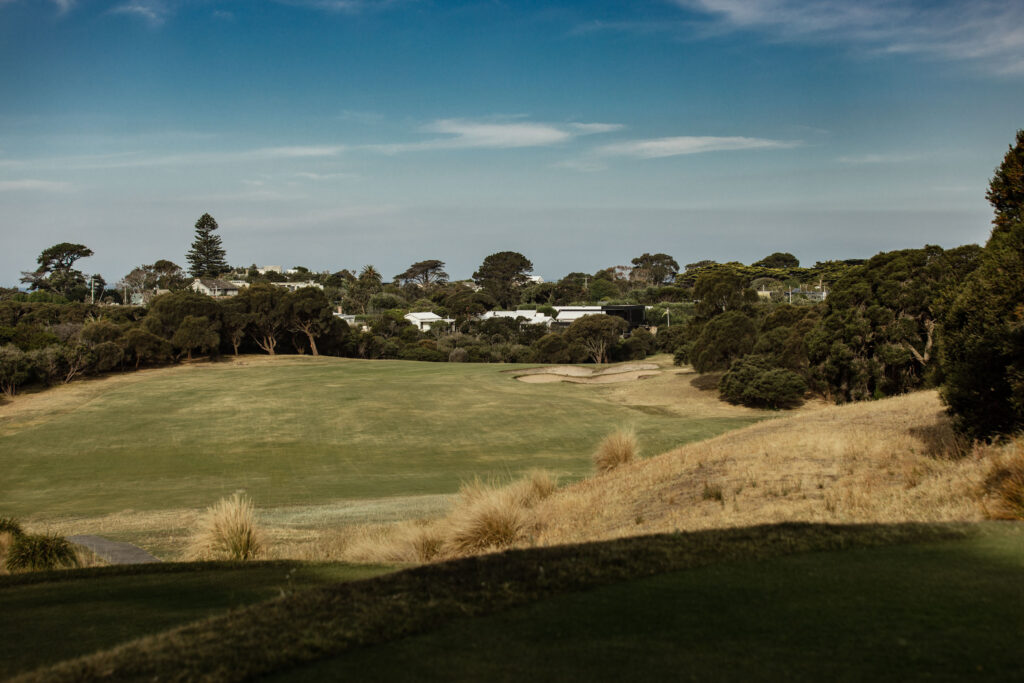
Current 4th hole Jack Howard