
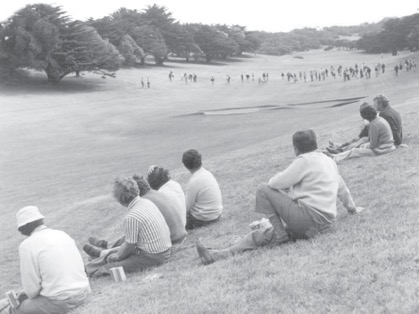
The people at the heart of Portsea Golf Club’s formation provide a veritable hands-across-the-waters connection to the many passionate folk who are driving their club into its second century. Common threads endure – of Melburnians with Mornington Peninsula weekenders, of retirees and lifelong locals, of people brought together by an unshakeable love of golf and the fulfilment that comes from being part of a community.
Then as now Portsea belonged to no one person, yet one name sits above all in turning a vision into an enduring reality.
Arthur William Relph and the Birth of a Vision
Arthur William Relph was a Melbourne businessman, a partner and director of Sargood Brothers, merchants who imported a range of goods including glassware, crockery, stationery and pianos from China, Japan, India and other exotic lands. A native Sydneysider, he was among the founders of the Manly Surf Club in 1907. By the early 1920s he was a regular visitor to Portsea where he had a holiday house on the foreshore of Weeroona Bay.
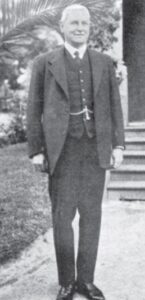
Arthur Relph
His account of a post-swim stroll early in 1923 gave Syd Thomson and Pauline Powell’s 2001 book about Portsea Golf Club’s first 75 years its delightful title – Within A Bull’s Roar.
“One Sunday afternoon in May … having had my regulation dip off the pier, and feeling the need for exercise to restore the circulation, I set off to walk to the Back Beach and instead of taking the road walked toward Quarantine. Seeing a fine piece of cleared undulating country stretching away toward the ocean, I vaulted the fence and made my way toward a hill in the centre. Immediately the idea seized me, ‘What a magnificent golf links this country would make.’
“I reached the summit of the (Delgany) hill and looked out over the ti-tree to the magnificent view and suddenly heard a muffled roar. I turned to behold a big black bull charging toward me. I did not wait for him but after a sharp sprint of 50 yards, scrambled over a fence that happened to be handy … Once seized with the idea, I could not rest until I found out who owned this piece of country. And also I was careful to enquire who owned the bull.”
The bull’s paddock became Relph’s obsession. As a member and Captain of Riversdale, he knew too well the frustration of Melbourne’s second-oldest golf club’s struggle to secure freehold land, having been moved on from courses it had built in Box Hill and Camberwell.
Bull’s Roar noted that in envisaging Portsea Golf Club he was determined to secure a site “from which we could not be driven out”.
The land’s owners weren’t hard to track down. Kathleen and Mabel Cain were the granddaughters of James Sandle Ford, who was transported to Van Diemen’s Land in 1831 having been convicted of machine breaking. Ford is credited with naming Portsea (after the Hampshire city), where he settled as a free man in 1841. He built the original Portsea pier and started a bar that grew into the Nepean Hotel.
In 1923 the ‘Misses Cain’ were managing the Nepean, which stood on the hill opposite the Portsea Hotel until its demolition in the early 1970s. The Cains were community-minded and renowned for their hospitality. They offered Relph the land for 4000 pounds. He took out an option over the sale of the property and set about finding investors with the intent that, once a golf course was built and the club established, members would buy the land and investors would walk away happy.
When only half the required money was raised, Relph’s friend William Gudgeon, an accountant, suggested that if not all of the land was needed for the golf course, allowing for the subdivision and sale of any non-essential land may be pertinent. On June 23, 1923 Relph registered The Portsea Lands Company Pty Ltd, which set about selling 100 shares at 100 pounds each. Shareholders were limited to 50; initially, 48 applicants – including prominent businessmen and seven women – applied to purchase 60 shares, with the Cain family taking up a number of them.
Company directors were all friends of Arthur Relph and had holiday or permanent homes at Portsea. Among them was Harold Armytage, who would become Portsea Golf Club’s first president and whose name endures via the annual contesting of the Armytage Cup.
Harold’s grandfather had arrived in Tasmania from England via Sydney in 1815, an engineer and a free man who was immediately robbed of his few goods. This proved but a minor setback; two generations later the Armytage property portfolio included stations at Mt Sturgeon on the Wannon River, Ingleby on the Barwon, The Hermitage in Pakington St Geelong, and Como in South Yarra.
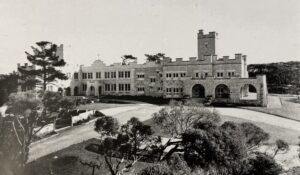
Delgany Estate
And by 1923 Delgany Estate, a sandstone castle with an imposing flag tower abutting the soon-to-be Portsea golf course that was designed by celebrated architect Harold Desbrowe-Annear. It has stood watch over its golfing neighbour through a century of evolution and growth, and remains a visual treat for all who traverse Portsea’s fairways.
Mabel Cain wrote to Arthur Relph on Nepean Hotel letterhead on June 18, 1923 expressing a willingness to help with clearing of the 96 acres that would include the new golf course. The Cains had previously cleared part of the site to grow wheat; furrows remained visible through various course alterations in forthcoming years.
Building the Course
Relph took charge of organising course construction, enlisting John ‘Jock’ Young to design the holes after seeing the celebrated work carried out by the native of St Andrews, Scotland in his role as greenkeeper at Riversdale. Young recalled in Bull’s Roar that “the clearing of the ti-tree was no easy matter, but with the help of 15 men, in 12 months there was space sufficient to start the holes”. The course was ploughed and levelled, and the tedious work of hand-planting couch roots on fairways carried out – by no means for the last time.
Here was an early window on Portsea’s adherence to French writer Jean-Baptiste Alphonse Karr’s maxim, ‘Plus ça change, plus c’est la même chose – the more things change, the more they stay the same.’ Water to bed in the fairways was initially drawn from the well at Delgany. Accessing sufficient supply to maintain the golf course would remain a constant challenge through the club’s first century, with the underground irrigation project undertaken in 2024 the most significant advance since the club’s inception.
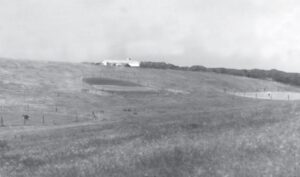
Early photo of course clearing or ti-tree landscape
Rabbits and noxious weeds were another enduring headache. Generations of golf club members have helped with further plugging of couch sprigs and clearing of ti-tree (the latter was so dense that even after the first nine holes were constructed golfers could get lost looking for balls).
As momentum built, Young recommended his nephew, Alexander ‘Sandy’ Cunningham, to Relph as a prospective greenkeeper. Still in his 20s, quite deaf and with a broad Scottish accent, Cunningham had worked and caddied at St Andrews before serving in the ‘Black Watch’ during the Great War.
Bull’s Roar reports that he was “very particular and punctual”, and once phoned Relph in Melbourne complaining that a worker had turned up five minutes late, insisting he be sacked. Relph eventually persuaded him to give the worker another chance. He would later credit Cunningham’s work ethic with the golf course being laid out so cheaply.
Paying local lads sixpence per day to collect lumps of limestone from the fairways helped compensate for a lack of labourers, and after 18 months of backbreaking toil the first incarnation of the Portsea course was opened to holiday visitors for a nominal fee in December 1924 and Easter 1925.
Relph turned his focus to alerting the public to his pride and joy’s existence, and showed considerable promotional and marketing flair in doing so. An article appearing in the Melbourne press under the headline ‘Exclusive Portsea’ implored golf enthusiasts to give the new “model golf links” a try:
“The golf course … is on 120 acres of rugged beautiful country, strikingly like a portion of Scotland … Pretty views are to be had on every hilltop. It is to have 18 holes, two of which will overlook the wild ocean scenery on the back beach.”
It would be another four decades before the course boasted a full 18 holes.
Early Finances
The building of Delgany two years earlier had created a shortage of both sandstone and labour, requiring a pausing of club house plans in favour of a simpler, temporary structure. At the end of April, 1925 the Portsea Lands Company recorded 4000 pounds having been spent on the land purchase, 1905 pounds on the golf course and 165 pounds on machinery, leaving just 500 pounds in its coffers and making shareholders nervous.
An extraordinary general meeting was held prior to the AGM on May 7, at which Relph confirmed that the course would be ready to hand over to a golf club by January 1, 1926. He also recommended the private sale of the first subdivision of eight acres of land adjacent to Point Nepean Road, although initial sales were hampered by an oversight in registering the subdivision with the Titles Office.
Relph’s enthusiasm for his project overrode any concerns. He told the AGM the course had the potential to become one of the finest in Australia. His promotion of the Portsea Golf Links Estate continued apace, hailing its proximity to Melbourne, “two hours by car or by steamer to Sorrento, two minutes from the finest and most fashionable bathing beach in Australia, with electric light and a telephone service, an excellent water service and probably the most picturesque golf links in Australia”.
Enthusiastic, certainly. Realistic, perhaps not. At the time, the road to Melbourne was unsealed and heavily potholed, and a trying journey could take up to four hours. By the mid-1920s the steamer, once such a regular fixture on the Peninsula, called only infrequently.
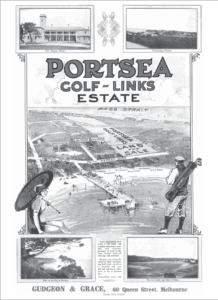
Portsea Golf Links Poster
With the clock ticking towards the January 1 deadline the club house – the first of three in Portsea’s history – was constructed of timber, a simple structure consisting of a broad verandah, a central main room and four anterooms. It was finished in time for the handover and would remain “temporary” for 67 years.
The Portsea Lands Company’s records after 1925 are sketchy. The 1929 balance sheet confirmed that the golf club leased 91 acres, including land abutting the ocean. Following legal advice it was deemed the most effective means of returning capital was to liquidate the company, whose last recorded meeting was held in 1934.
Eventually all blocks between Point Nepean Road and Relph Avenue were sold. Bull’s Roar reports that no records remain regarding land sales between London Bridge Road and the Ocean Reserve, “although shareholders may have insisted on the sale of the back beach land to recover their investment”. How significant this land might have been had the club managed to hang onto it is the stuff of dreamy speculation.
Creating the Portsea Golf Club
The Union Steamship Buildings at 27-31 King St Melbourne hosted a meeting in October, 1925 at which participants agreed the Portsea Golf Club would commence operation on January 1, 1926. The majority of those in attendance were shareholders of the Portsea Lands Company, who hoped to gather support from “like-minded city members who were attracted by the idea of playing golf and holidaying in the Portsea area”. In doing so, land sales would improve and their investment would be protected.

First minutes resolving to create the Club
The golf club’s founding committee comprised “men of considerable means and influence, which augured well for the club’s future”. Among them was CL (Leslie) Kimpton, who owned a house next to Arthur Relph’s by the bay and whose various presidencies included the Royal Victorian Institute for the Blind, the Victorian Chamber of Commerce and the Australian Club.
Harold Armytage was elected inaugural President and introduced several new members including his horse racing buddy LKS Mackinnon. Armytage donated a cup for the club’s first Open meeting and was regarded as “a cornerstone of the club”. Having retired to Delgany, he was too unwell to attend any formal meetings during his time as President. He died within a year of the club’s inception, aged 64.
The first formal meeting of the committee was held on New Year’s Eve 1925, chaired by Captain Arthur Relph, a position he would hold until his death in 1948. Twenty-nine members were elected including 10 ladies, with most travelling to their holiday homes from Melbourne on weekends. Subscriptions had been set at two guineas for gentlemen and one guinea for ladies and children under 14. Green fees were set at 2/6d per day for men and 1/6d for ladies. The putting green (near the club house and hailed as giving the impression of a cluster of turf cricket pitches of varying lengths) could be used for one shilling for a half-day, including putter and ball.
A resolution from that first committee meeting was to ask the local butcher, Mr Wilson, to graze sheep on the course. The practice originated in Scotland and was thought to be a precursor to modern-day bunkers, which were placed in the hollows left over time by flocks of sheep that would huddle together to shelter from harsh weather.
Portsea was soon attracting the sort of rave reviews Relph and his fellow pioneers had dreamt of.
In February, 1926 ‘T.E.E.’ from Table Talk magazine wrote of the golf course and the men behind it:
“All golfers who went to Sorrento for the Annual Open meeting had heard that nearby at Portsea some well-known men in the world of golf had formed a club and had energetically set about the perfecting of a course. Most, if not all, of the visitors thought that there would probably be available for a round a few holes, pleasant, but rough. Every golfer who went along to see the new layout got a huge surprise.
“Half because they knew someone interested and half out of tolerant curiosity, they wended their ways past the magnificent freestone castle of Mr Harold Armytage (a structure almost unique in Australia) and onto the course … The links set all who saw it talking and prognosticating a great future.
“We should have expected no less when we knew the personnel of the moving spirits. They are big men in every sense – outlook, business and golf in particular. AW Relph (captain) is well-known at Riversdale and few men could display the energy and enthusiasm in a golfing objective that this fine, big personality has shown in his tireless efforts to give Portsea the one big attraction that it lacked.
“The most exclusive seaside resort in Victoria, adorned with the holiday homes of the state’s best-known families, the resting and playing ground of wealth, youth and beauty, had until now no golf links.”
A Flourishing Community
Word of mouth and Relph’s canny marketing had immediate results, with 94 applicants granted membership within the first three months of the club’s existence. These included many of the remaining shareholders from the Portsea Lands Company, family and friends of the committee, along with the Misses Cain.
A collegiate atmosphere took hold, with committee and ordinary members taking great interest in their new golf course and assisting with working bees to clear ground, plant trees and complete the many projects that a veritable blank canvas presents. Here was the earliest incarnation of volunteerism that remains an enduring asset to the club, most evident in recent times through the work of ‘Dad’s Army’ and the Paramatta grass dabbers.
The club’s inaugural year was hailed as a resounding success. In late December 1926, Harlequin of the Morning Post enthused over the course’s potential and – as noted in Bull’s Roar and almost certainly worded up by Arthur Relph – predicted an increase in fees and the building of a permanent club house out of local stone once the proposed 18 holes were completed. The stone club house never materialised.
AO “Artie” Barrett
January 21, 1927 is significant when viewing the club’s story through the lens of its people, as the day AO ‘Artie’ Barrett became a member. Aged 57 at the time, he had founded and managed a number of successful malt businesses in Melbourne. Almost immediately he donated 5 pounds to improve the gradient between the fourth green and fifth tee. Within 13 months he became the club’s second president, filling the breach left by the death of Harold Armytage. Over the next 20 years his contribution would render Barrett one of Portsea’s favourite sons.
He’s also one of its most interesting. Born in England, Barrett owned one of Portsea’s most beautiful holiday homes, Arlescote Wood, and was a foundation member of the Royal Automobile Club of Victoria and a member of the Australian Club. Yet it was his athletic feats as a younger man that gave him fame that stretched far beyond the Peninsula.
Barrett was Victoria’s first champion race walker (or “racing walker”, as he preferred). He won the 1 and 3-mile walks at the first track and field championships held by the Victorian Amateur Athletic Association in 1891, and three years later set a Victorian record for 5 miles of 40 minutes 30 seconds that stood for many years. He competed in New Zealand and successfully at Australasian Championships, and as an administrator drafted the rules that were adopted to formally govern race-walking.
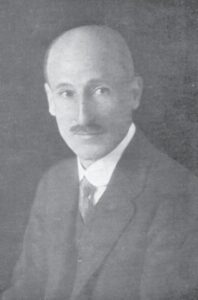
AO Barrett
He was also a passionate amateur botanist who, as well as penning a guide of practical race-walking hints, wrote three books about Australian eucalypts. Australia’s Entails was hailed at the time of publication in 1937 as “the most thrillingly romantic work ever written on trees in general and gum trees in particular”. Of his great horticultural love Barrett wrote, “Gum trees are like good words: they never die.”
He also penned a remarkable account of walking from Melbourne to Sorrento one January day in 1893, an impromptu undertaking that Bull’s Roar reports came about because he missed the bay steamer and was fearful that a rival suitor for the hand of his future wife would swoop in his absence. So he walked through afternoon, evening and night to propose.
Barrett’s account makes no mention of being spurred by love. It is an incredible story nonetheless, beginning on Princes Bridge at 2.40pm “in a highly disgruntled frame of mind having missed the boat to Sorrento”. The temperature was 103 degrees in the shade. Still, an idea struck him. “The earth is flat, and I am on the surface of it. It is only 40 miles, and, if I walk along the beach, I will be there by 11pm! Why not?”
The subsequent odyssey could be a movie. Barrett’s first stop was the Elsternwick Hotel to ask directions, followed by the Mordialloc Hotel “where I had a good wash and drank a gallon of water”. Passing through the Carrum Hotel dining room (where he drank two bottles of beer and ate the inside of an apple pie) he encountered his old Melbourne Grammar schoolmaster, who thought his undertaking an act of madness. When a heel blister emerged as he passed through Frankston, Barrett might have agreed. But he found himself “completely refreshed” after stamping on it until it burst.
Once darkness had fallen so did Barrett – twice on stony ground. Feeling himself close to perishing with thirst, he encountered dried creek beds, a house whose garden taps were guarded by fierce dogs and eventually two old school mates on horse and buggy whose female companion offered him a most-welcome bottle of milk. At 4.45am, with Sorrento’s lights in sight, he lay down and slept – only to be woken by an evangelist who thought he was a drunk and implored Barrett to seek the Lord.
“I have just walked down here from Melbourne,” Barrett responded.
His account concluded, “And that is how my walking began.”
Oil Dreams
Years later, Barrett’s generosity towards his adopted and much-loved club kick-started a chain of events that ultimately led to a newspaper report citing that “the 12-hole Portsea Golf Club nearly achieved worldwide fame”. In 1929 Barrett purchased a new engine, pump and necessary piping to improve water supply to the course by piping it from a well that was already in use up to the water tower on one of the highest parts of the course.
Nearly a decade later, early in 1938, Cunningham spotted traces of oil at the well where the pump was situated. The site was pegged and an application made for approval to drill for oil. For several weeks members dreamed of how the prospective riches of their discovery would tick off every item on the still-fledgling golf club’s wish list. Alas, analysis from samples revealed a leaking pump engine.
“It was very exciting while it lasted,” AO Barrett said. “And it took six months growth out of me!”
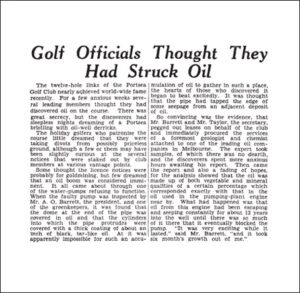
Oil News Article
By the end of the 1920s Portsea appeared to be well established and financially secure. In May 1929, following negotiations by Arthur Relph, the club accepted an offer from the Misses Armytage and their sister, Mrs Fitzpatrick, to purchase the land from the Portsea Lands Company and lease it to the club. After 21 years would be given the option to buy the land for the same price paid by the sisters.
Membership had climbed beyond 100, most still commuting from Melbourne. The course boasted 11 holes and had hosted three successful Open events. In a matter of years Portsea found itself on the golfing map. And in the blink of an eye the Depression and war sent shudders through the club in almost every way imaginable.
A Depressing Reality
Differences of opinion and outlook between the club’s most influential people, Relph and Barrett, deepened as the prospect of a second world war heightened. A proposal by Barrett to increase the number of holes to 15 was knocked back by the committee. Arthur Relph’s observation at the 1930 AGM that the course had suffered from “bad management” appeared to be a thinly-veiled swipe at Barrett and Cunningham. By November that year Barrett had resigned as President.
He would return to the post in 1934, and indeed by the 1931 AGM it was clear Relph and Barrett were on decent terms again as a special vote of thanks was passed to the Barrett family for their generous donation of funds and time. The committee also resolved to make AO Barrett Portsea’s first Life Member.
The challenging climate took a toll as members who were experiencing financial difficulties resigned, impacting the club’s financial position. Sandy Cunningham’s wages were reduced by 10 percent in 1931. Jack Howard (Cunningham’s assistant who was known as “The Boy” until he turned 18 and who would become an influential Portsea curator and Life Member) was laid off the following year. Here Barrett’s generosity came to the fore again, with Howard later recalling that he would often arrive in his big Minerva car (which Jack thought looked like a hearse) on a Friday afternoon and pay him to spend the weekend working in the garden of his Portsea home.
Arguably the most exacting club role through this period of global upheaval was held by Honorary Secretary Herbert Taylor, who like Barrett tendered his resignation in 1930 due to club duties interfering with his professional work. Fully aware of his importance, the club offered Taylor’s chartered accounting business 30 pounds per annum to provide clerical assistance. A “handsome, inscribed golf bag” presented to Taylor during the 1931 Open won him over; he remained Honorary Secretary until 1945, overseeing finances through the most difficult period in Portsea history.
Barrett’s ability to rally support for golf club projects, even in the most difficult of economic times, was commendable. In 1934, as the club celebrated its eighth birthday at the Nepean Hotel, half a world away Adolf Hitler was preparing to abolish the office of President and declare himself Fuhrer of Germany and its people. Yet global unease did not deter Barrett from his latest mission.
He implored all present at the birthday gathering to fund a new 15,000-gallon concrete water tank. Within three months the tower – more than three metres in diameter and roofed in concrete – was built by Hansen and Yuncken, with Otto Yuncken providing the funds to finish the job when subscriptions fell short.
As the decade progressed and war loomed larger, membership and committee numbers actually increased. In 1937 the committee offered the local vicar and priest honorary membership; the following year 32 new membership applications were accepted, including associates Jo Moody and Doll Spunner.
The number of local members reached 50, a growth that soon caused headaches as some – who paid only half of the full subscription and were expected to play on weekdays – started playing on Sundays and “spending too much time in the limited space available at the clubhouse”. Local membership was restricted to Portsea residents, a move that Bull’s Roar notes “would almost bring about the closure of the club during the looming and difficult war years”.
War Years and Survival
As hostilities commenced in Europe, the stark reality of a world at war made its way to Portsea. Members of the 5th Battalion, Victorian Scottish Regiment who could not be accommodated at the Franklin Barracks set up a tented camp on the first fairway, rendering the course virtually unplayable. Petrol rationing isolated the largely city-based committee. ‘Zoom’ was still seven decades away; committee meetings ground to a halt.
Many members enlisted in the armed forces, along with Jack Howard, which left Sandy Cunningham to tend the course solo. Membership declined accordingly. When Japan entered the war in 1942 the army, fearing a Point Nepean invasion, dug trenches and placed barbed wire across many fairways.

The Governor-General of the Commonwealth, Lord Gowrie, inspecting the Victorian Scottish Regiment during a visit to its camp on the Golf Course at Portsea, Victoria, in early November 1939.
The Armytage sisters were again crucial in supplying a lifeline, deferring rent payments throughout the war and almost certainly saving the club from liquidation. By 1944 it was rumoured the course would have to close for the duration of the war, with Relph detailing his dire concerns – and his own personal struggles and declining health – in a letter to Captain Sydney Newing, a medical officer at the Portsea Camp Hospital.
“I have not had a day off for 15 months and it is quite impossible for me to get away and my wife has been practically laid up for five months, being attended at home by the district nurse … We are not able to get any help in the house and she needs my attention every night. My daughter (who lived with us) passed away recently after six months illness (cancer). My own health is not too good and I badly need a rest.”
Mercifully, help was at hand. Captain Newing proposed having patients at the camp hospital – some of whom were already playing golf as part of their rehabilitation – help to maintain the course with the old single gang mower. Tom Houghton from the Portsea Hotel got on board, and the pair oversaw Cunningham’s work and cut the fairways themselves with the horse-drawn mower.
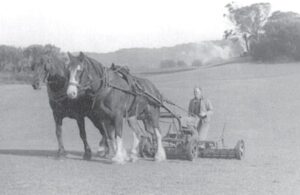
Horse drawn mower
Other regular contributors continued to go above and beyond. Barrett paid 100 pounds to overhaul the water pump he’d bought more than a decade earlier. Arthur Relph, Les Kimpton and Otto Yuncken provided 10 shillings each per week to keep the club afloat. Tom Houghton, who would join the committee in 1947, later bore the initial expense of connecting the club to the State Rivers and Water Supply.
Rebuilding and Securing the Future
When Herbert Taylor retired at the AGM in March 1945, Arthur Relph’s son Jack, a chartered accountant who had won a number of Portsea events as a boy, took on the position of honorary secretary. Taylor became the club’s second Life Member, and the junior Relph followed his father’s footsteps in embarking on a long and influential journey as a club visionary.
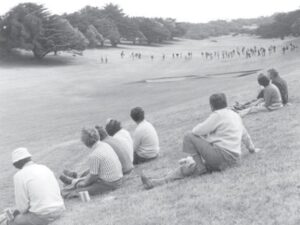
Current 8th hole in the 40s
After the war ended, purchasing the leased land and securing the club’s future became a priority. Jack Relph drew up schemes to finance the purchase, and the process was formalised at an Extraordinary General Meeting in July 1949 when the committee decided to form a company in which members could purchase debentures for a minimum of 10 pounds. This provided the Armytage sisters with a downpayment of 2000 pounds, with the remaining 2485 pounds to be paid after five years.
Finally, Arthur Relph’s vision of a Portsea Golf Club thriving on its own land had become a reality. Sadly, Relph didn’t live to see it, having died at his Canterbury home on August 9, 1948 aged 77.
“As the club’s history records, Relph had been the linchpin of the club’s foundation and survival. The position of captain, which he held up until his death, was left vacant. He died before he could be made a life member.”