

The first Europeans to inhabit what would become Portsea were graziers and lime burners who arrived in 1838, 35 years after an aborted attempt to establish a permanent settlement at Sullivan Bay near Sorrento.
Among them was James Sandle Ford, a convict from Tasmania, who took up a lease in April 1844. Ford was originally from Havant in Hampshire, and named the area Portsea after the island off the south England coast. Ford and others, including his brothers in law the Sullivans, made a living from lime burning and farming for many years.
The Quarantine Station was built in 1852 and provided a ready market for their wares, while also causing a number of leaseholders to be evicted. Ford (on reduced acreage) was able to continue providing stores for the visiting ships.
By the 1860s legislation had been introduced to allow people to purchase Crown Lands. Ford and other locals bought acreage on and around their existing leases, but much was bought by wealthy people from Melbourne. This was the beginning of the shift from lime burning and agriculture to holiday accommodation that continues today.
In the 1880s fortifications at The Heads brought the military to Portsea, where they remained in one form or another into the 1980s.
By 1926, when the golf club was founded, Portsea was a relatively small settlement with 88 people on the electoral role and still a four-hour drive from Melbourne on rough, unmade roads. Yet it was already a developing resort town known for its beaches and as a popular holiday destination.
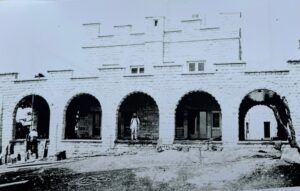
Building Delgany
- New houses with distinctive architecture were being built. One notable large limestone residence, built in 1925, was Delgany – its inhabitants, the Armytage family, would play a significant role in the formation of Portsea Golf Club. Another was Ilyuka Beach House, which was built on the cliff tops by an American oil baron. Its architecture resembles the Spanish Mission style that was popular in California at the time.
- Portsea’s front beach was a vibrant scene during the holiday season, with crowds of bathers and holiday-makers, colourful umbrellas and various watercraft anchored off the pier. The Portsea Pier was a focal point.
- The key holiday establishments were the Portsea Hotel and the Nepean Hotel, situated opposite each other on Point Nepean Road. The owners of the Nepean Hotel, the Cain family, would also play an important role in the early development of Portsea Golf Club.
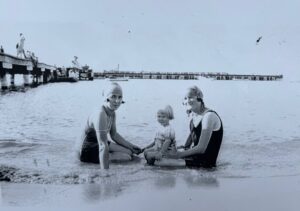
At the front beach – Portsea
- To support the influx of holiday-makers, many locals made “other arrangements” over the summer and rented out their homes to visitors. For example the Watson brothers, who had fished at Portsea since the 1860s, took up residence in their fishing huts and rented out their homes on Point Nepean Road.
- Ford’s original homestead and the cypress trees he planted along Point Nepean Road remain features of the landscape.
The following article was written by Falaise and published in the Australasian, depicting the vibrant holiday season at Portsea.
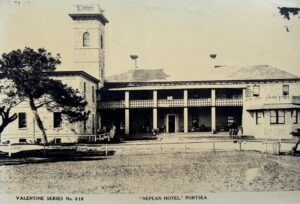
The Nepean Hotel
“Portsea has been, perhaps, the favourite seaside resort for the holiday season, and former overseas travellers who have been enjoying its attractions and diversions state that it has resembled Ostend for several weeks past. The hotels, boarding houses, and furnished cottages have all been filled to overflowing, and many, visitors, have put up with “shake-downs” and camps rather than forego the allurements of the place. The principal pastime of course, aquatic sport, and each forenoon hundreds, of visitors assemble in the vicinity of the pier, for those who no longer enjoy sea bathing take pleasure in viewing others at it. Motorcars bring bathers from Sorrento and the outlying cottages of Portsea, and when wraps are discarded many effective and striking costumes are in evidence, for the bathers vie with each other not only an aquatic achievements, but also in the smartness of their attire, which as a rule is complete by hose and shoes.
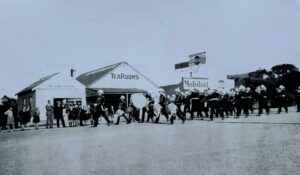
Portsea main street
Some of the bathers are experts at diving from the pier. Running “headers,” somersaults, and backward movements are freely indulged in to the edification of the onlookers, whilst occasionally one more venturesome than the others will try a “header” from the deck of the bay steamer whilst it lies alongside.
“The bathers have no fear of sharks, being, it is said, of opinion that those waters are not invaded by the monsters.”
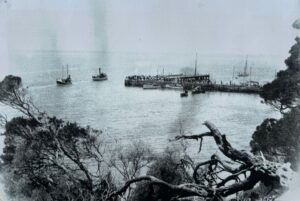
Portsea Pier
A feature of the Portsea season has been aqua-planking; this thrilling sport has been a delight to many of the girl bathers. A plank is attached to a yacht (usually Mr W. Howard Smith’s) by a tow line, and the bather then’ stands on it whilst the yacht races through the water, and, though balance is assisted by a hand-line from the boat, it is no easy matter to remain poised on the plank.”
A number of Melbourne families who were keen golfers would regularly make the long journey to their holiday homes in Portsea for weekends and holidays. They would become important early members of Portsea Golf Club.